MATERIUM
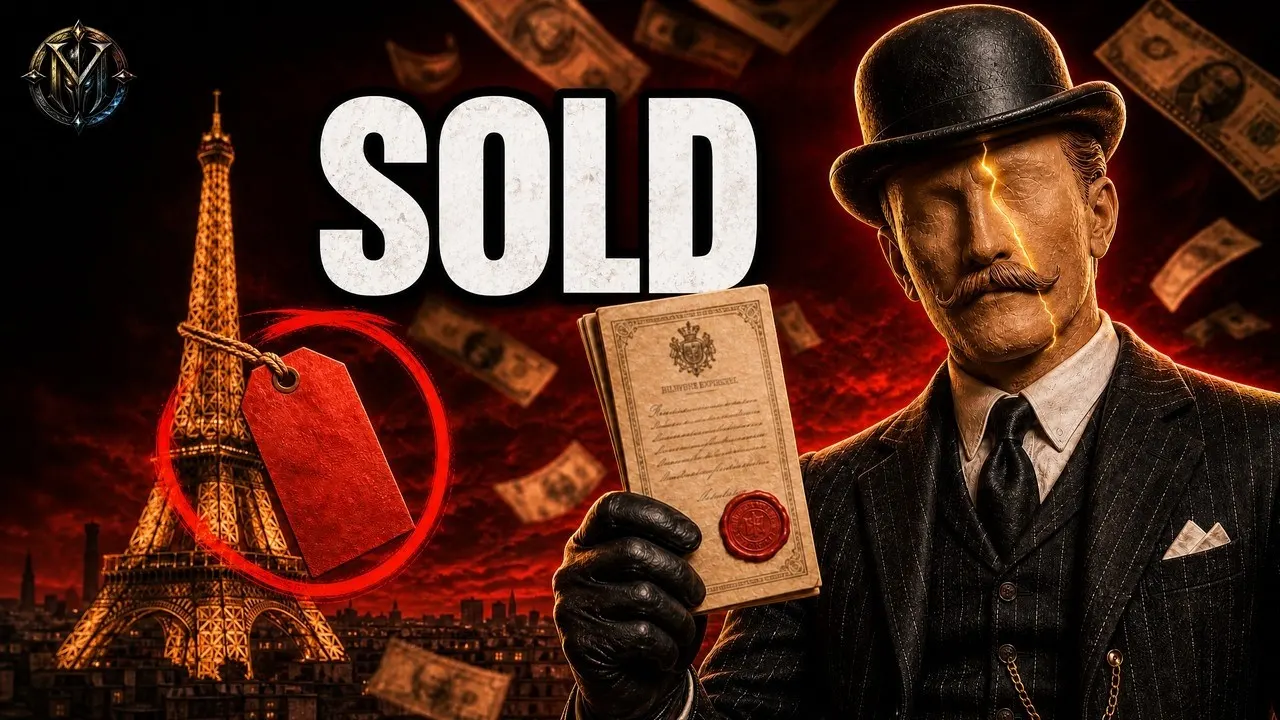
In May 1925, in Paris, Victor Lustig introduced himself to the city's leading scrap dealers as Deputy Director General of the Ministry of Posts and Telegraphs and told them the French state was going to tear down the Eiffel Tower and sell it for scrap. The businessman André Poisson paid the price and a bribe on top. Lustig took the money to Vienna, came back a month later to try again, and ended up in the United States, selling boxes that "duplicated" banknotes for $10,000 or more. He was arrested in New York on 10 May 1935 with $51,000 in counterfeit bills stored in a subway locker. He died in federal custody on 11 March 1947.
In 30 seconds
- Who: Victor Lustig, born on 4 January 1890 in Hostinné, Bohemia, then part of Austria-Hungary. He spoke five languages and used around 45 aliases.
- What: in 1925 he sold the Eiffel Tower for scrap while posing as an official of the Ministry of Posts and Telegraphs. The buyer, André Poisson, paid the price and a bribe.
- How he fell: in 1935, in New York, a single key led agents to a subway locker holding $51,000 in fake notes and the printing plates.
- The end: 15 years for counterfeiting plus 5 for escaping, 20 in total, at Alcatraz. He died of pneumonia in 1947. His death certificate reads "apprentice salesman".
Who was Victor Lustig?
The man who sold the Eiffel Tower called himself Count Victor Lustig, but very little of that identity was real. He was born in 1890 in Hostinné, a small town in Bohemia, and he made sure his past was hard to trace: he told a different version to almost everyone he met. Sources agree that he spoke five languages fluently and used at least 45 false identities, travelling with several passports.
By his early twenties he was moving around Europe dressed as an aristocrat, living off wealthy passengers on transatlantic liners. The method was simple. When the ship docked, the count disappeared. That ability to become someone else, and to leave before anyone asked questions, is the thread running through everything that followed.
How he sold the Eiffel Tower, step by step
1. A true story in the papers. In spring 1925, Lustig read that the Eiffel Tower was in poor condition, that painting and maintaining it cost a fortune, and that some Parisians would rather see it gone. The tower had been built for the 1889 Exposition and was never meant to last. Almost everything he was about to say was true.
2. Manufactured authority. He obtained forged Ministry of Posts and Telegraphs stationery and invented a made-to-measure title: Deputy Director General. Senior enough to discuss state matters, obscure enough that nobody would think to check.
3. Secrecy and exclusivity. He wrote to the most important scrap dealers in Paris and invited them to a suite in a grand hotel, not a government office. The excuse was discretion: the matter was too sensitive. There he announced that the government would sell the tower to the highest bidder, quietly, to avoid a public outcry.
4. The chosen target. Lustig singled out André Poisson, a businessman eager to join the ranks of the big players. Poisson had doubts. Why so much secrecy? Why a hotel? He asked for a private meeting.
5. The bribe as proof. Instead of producing more seals and signatures, Lustig hinted that an official like him was poorly paid and that whoever won the contract might wish to show some "gratitude". Poisson reasoned that a fraudster would pretend to be honest, and only a real official would dare to ask for money. He paid for the tower and paid the bribe.
Lustig boarded a train to Vienna with the cash. It is often said that Poisson, too embarrassed, never reported the fraud; that detail comes from later press retellings, as does the exact sum, which no reliable record confirms.
The second attempt and the money-printing box
A month later Lustig returned to Paris to run the same scheme on a new group of scrap dealers. This time one of them did what Poisson had not: he checked. He called the ministry, where nobody had heard of any sale, and went to the police. By the time officers reached the hotel, Lustig was already on his way to America. That is why the famous line "he sold the Eiffel Tower twice" is only half true. It was one completed sale and one failed attempt.
In the United States his product was the so-called Rumanian box, a mahogany case with slots, rollers and cranks that he claimed could copy banknotes. The buyer inserted a bill, waited around six hours, and two came out. The trick: the box was preloaded with genuine notes, one serial number digit altered so they looked like copies. If the buyer took the "duplicate" to a bank, the bank accepted it, because it was real money. He sold these boxes for $10,000 or more. One of his victims was a Texas sheriff.
There is also a story that he once conned Al Capone. Historians doubt it, and it may well have been spread by Lustig himself.
How he fell: the key, the escape and Alcatraz
The boxes meant hunting victims one at a time, and Lustig wanted scale. He teamed up with the engraver William Watts and began distributing very high-quality counterfeit bills, circulating in New York by 1934. Federal agents went after him.
On 10 May 1935 he was arrested in New York. He carried nothing incriminating except a key. It opened a locker in a subway station, and inside were $51,000 in counterfeit notes and the plates to print more.
He was held at the Federal Detention Headquarters in New York, a building said to be escape-proof. His trial was set for 2 September 1935. The day before, Lustig knotted his bedsheets into a rope and climbed down from a third-floor window. He was recaptured in Pittsburgh on 28 September. He pleaded guilty and received 15 years for counterfeiting and 5 for the escape. He served his sentence at Alcatraz.
In March 1947 he developed pneumonia and was moved to the Medical Center for Federal Prisoners in Springfield, Missouri, where he died on 11 March. He did not die on Alcatraz, as is often repeated. On his death certificate, under occupation, someone wrote "apprentice salesman".
The Law of Deception No. 1 and how to spot it today
The victim's greed does the con man's work. Lustig never had to persuade Poisson that the tower was for sale. Poisson wanted to believe it. The deal of a lifetime was on the table, and every reasonable doubt ran into the fear of losing it. The bribe did not stop him; it confirmed what he wanted to hear. And by accepting an irregular deal, the victim also trapped himself in silence.
The warning sign of this Law is specific: you're offered something far below its value, or returns far above normal, and the rush won't let you ask why you were chosen.
The same trap still works in new clothes:
- "Exclusive" investments in group chats. WhatsApp or Telegram groups promising fixed, very high returns in crypto or forex, with limited places and a request to keep it quiet. It is the hotel suite, online.
- The Rumanian box as an app. Platforms that let you withdraw a small profit at first so you can see that it "works". Like the genuine note at the bank, that first test is part of the setup.
- Giveaways that double what you send. Accounts impersonating celebrities or companies that promise to return twice the crypto you transfer.
- Impossible bargains. Cars, flats or tickets at half price on classified sites, from a seller in a hurry who wants a deposit before showing you anything.
The defence is the one that saved the second scrap dealer: verify outside the channel that brought you the offer. Call the institution, look up the official register, talk to someone you trust who gains nothing from the deal. If the offer cannot survive one phone call, it is not an offer.
The full story, including Lustig's real 1935 police mugshot, is in the first episode of MATERIUM.
 The full episodeHe Sold the Eiffel Tower and Ended Up in Alcatraz
Watch on YouTube
Frequently asked questions
Who sold the Eiffel Tower?
Victor Lustig, a con artist born in 1890 in Hostinné, Bohemia. In 1925 he posed as Deputy Director General of France's Ministry of Posts and Telegraphs and sold the tower for scrap to the businessman André Poisson.
Did Victor Lustig really sell the Eiffel Tower twice?
Not quite. The first sale went through: Poisson paid the price plus a bribe. A month later Lustig tried again with new scrap dealers, but one of them checked with the ministry, the scheme collapsed and Lustig fled to the United States without being paid.
What was Victor Lustig's money box?
The so-called Rumanian box, a mahogany case he claimed could duplicate banknotes in about six hours. It actually held hidden genuine notes with one serial number digit altered. He sold it for $10,000 or more.
How did Victor Lustig die?
While serving a 20-year sentence tied to Alcatraz. He caught pneumonia on 9 March 1947 and died on 11 March at the Medical Center for Federal Prisoners in Springfield, Missouri. His death certificate lists his occupation as 'apprentice salesman'.
Sources
- Wikipedia, Victor Lustig
- Smithsonian Magazine, The Man Who Sold the Eiffel Tower. Twice
- Smithsonian Magazine, The Smoothest Con Man That Ever Lived
- New York Almanack, Victor Lustig: Conman and Counterfeiter
- American Numismatic Society, Kings of Counterfeiting
- The Mob Museum, The long con of underworld grifter 'Count' Victor Lustig
- All That's Interesting, The Many Cons of Victor Lustig
- Mental Floss, How Con Man 'Count' Victor Lustig Sold the Eiffel Tower
- Casino.org, How Lustig's Money Machine Scam Worked