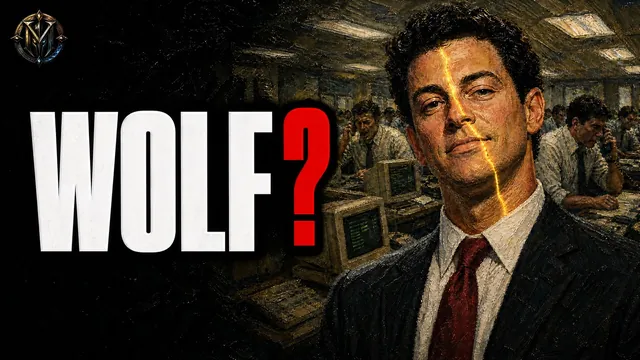
A bankrupt Texan got himself knighted in the Caribbean and turned his "safe" bank into a $7 billion Ponzi scheme. This is the story of Allen Stanford and the Latin American families who trusted him with their savings to protect them.
He reinvented himself on the island of Antigua: he lent the government at least $85 million, won over the head of the financial regulator, and for almost twenty years sold certificates of deposit that paid more than any bank. Since 1990, the books were fake. Wall Street's cop suspected him as early as 1997, but the man who exposed him was a Venezuelan analyst. In 2012 he was sentenced to 110 years in prison.
Chapter 7 of 16 of MATERIUM Season 1 · Law No. 7 of the Manual of Deception: "The saver's fear is the con man's capital."
Episode transcript
The full narration, split by the video chapters.
0:00 Twenty million in a glass box
Nineteen ninety-seven. The SEC already suspected a Ponzi. It took twelve years to stop him. Twenty million dollars in a glass box.
London, two thousand eight. A helicopter lands on the most famous cricket ground in the world. Out steps a Texan with a knighthood. The winner takes it all.
Eight months later, thousands of Latin American families will learn where that money came from. It was theirs.
0:35 Sir Allen Stanford
His name was Allen Stanford. Sir Allen Stanford. Worth two point two billion dollars, according to Forbes. His bank, on a Caribbean island, didn't sell returns.
It sold shelter. You think Ponzi victims are blinded by greed. These people were blinded by fear. They moved their savings abroad to protect them… and carried them straight to where they'd lose them.
Sixty-eight days after Madoff, Stanford fell. Same scheme. New disguise. Today you'll find out what was really in that box.
Why Wall Street's cop suspected him as early as nineteen ninety-seven… and took twelve years to act. And where those families' money is today.
1:26 A Texan gone bust
Allen was born in small-town Texas. His first business: a chain of gyms in Waco. It grew fast. He bought a Jaguar.
And a helicopter. Remember that helicopter. In nineteen eighty-two, he went bust: thirteen and a half million in debt, two hundred thousand in assets. According to several profiles, he spent a while making empanadas at a burger joint.
His version, as told to Forbes: My father and I bought distressed buildings in Houston. We made several hundred million. The record says something stranger. By around nineteen eighty-five, the empanada man already owned a bank.
2:12 The island that opened the door
How does a freshly bankrupt man open a bank? He finds the right island. On Montserrat, a British island in the Caribbean, there were some three hundred banks. Nearly all of them on paper.
When British police began shutting them down, Stanford handed back his license just in time. And moved one island over: Antigua. There, the prime minister asked him to rescue a struggling local bank. Count me in, Prime Minister.
I'll take that bank. He rescued it. And the island started to owe him. Now, here's what almost nobody knows.
His chief financial officer, James Davis, his college roommate, admitted years later: since nineteen ninety, the bank's books had been fake. The crisis didn't break it. It was always a lie.
3:10 Caracas: fear as the engine
To fill a bank like that, Stanford went looking for frightened customers. Picture a family in Caracas. Inflation is over thirty percent. The government controls the dollars.
Nobody knows what Chávez will do with your money. You've been saving for twenty years. Where can you hide it so nobody takes it? Stanford had the answer.
You walked into a Stanford office in Venezuela and came out with an Antiguan bank certificate. At seven percent: nearly double the U.S. rate. Your money is in liquid assets. Over twenty analysts watch it.
And the regulator audits it. I didn't trust the banks here. I was afraid the government would take my money. Fear doesn't ask for proof.
It asks for shelter. Maybe this sounds familiar. If you, or someone in your family, were ever offered a way to keep your savings 'safe' outside the country, at an interest rate nobody else paid, tell us in the comments. Your story could be the warning another family needs.
And note who's the threat and who's the shelter. By the end, the roles will be reversed.
4:28 The shelter salesmen
But fear only opens the door. To walk through it, you needed salesmen. Each adviser earned one percent of every dollar he put into certificates. The offices competed like teams.
The Houston one: the Texas Tequila Twisters. Seven percent, in dollars. And insured by Lloyd's of London. And what if something happens to the bank?
That's what the jet was for. Anyone with over five million got a private jet to the island. They came back convinced. And the Lloyd's insurance?
It existed. But it protected the executives, not your money. One adviser, Leyla Wydler, looked into it. She refused to sell them, and she was fired.
The next year, she put it in an arbitration claim: This firm is engaged in a Ponzi scheme to defraud its clients. Nobody passed it on to investigators. Hold on to this detail: the adviser in your own country who sold you the certificate. Many years from now, in one single country, that detail will be the key to getting the money back.
5:44 The numbers were decided first
But first, the question almost nobody asked: how does a bank pay double what everyone else does? The answer was simple. It didn't. In nineteen ninety-five, his bank reported a return of fifteen point seven one percent.
In nineteen ninety-six… the exact same number. The SEC called it 'a statistical impossibility.' Davis described the method at trial: first they picked the number, then they made up the books. Put down ten percent this year. Make the numbers work.
As always, Allen. Over eighty percent was 'other assets': inflated land, half-built companies… and personal loans to a single customer: Allen Stanford. At least one point six billion. The bank was his ATM.
And in the reports to clients, year after year, perfect numbers. Remember them. He'd forget them.
6:54 The "blood brother" regulator
A bank like that only survives if nobody looks. And in Antigua, Stanford made sure of that. He lent the government at least eighty-five million dollars. Only one man could stop him: Leroy King, the head of the financial regulator.
According to Davis, in two thousand three the two became 'blood brothers.' They cut their wrists and pressed the blood together. From then on, King called him 'Big Brother.' What's documented: more than five hundred twenty thousand dollars in cash, two Super Bowls and private jet flights. When the SEC asked for his help, King replied in writing: Our agency does not have the authority to act in the manner requested. In two thousand six, Antigua knighted him.
His website put it this way: Knighted by His Royal Highness, Prince Edward. According to the British press, Buckingham Palace called it 'incorrect.' The 'Sir' was real. But it came from a government in his debt.
8:09 The SEC knew since 1997
One watchdog was left, off the island: the SEC, Wall Street's cop. In nineteen ninety-seven, its examiners in Fort Worth concluded: it's probably a Ponzi. They said it three more times. Nobody acted.
A veteran, about to retire, warned a boss: Watch these people. It looks like a Ponzi scheme to me. And someday it's going to blow up. Fort Worth's head of enforcement left the SEC.
The next year, he billed hours to Stanford. The examiner who pushed hardest, Julie Preuitt, summed it up before Congress: I paid a very high price for complaining. The bank grew from two hundred fifty million to seven billion. Now I'm asking you.
Who's more to blame: the con man, or the people who saw it coming and did nothing? Tell me in the comments. In the end, it wasn't them. It would take someone nobody paid to watch him.
But first, the world came crashing down.
9:25 What was in the box?
Back to Lord's. According to The Times, that helicopter wasn't even his. It was rented: the company painted Stanford's logo on it for the day. And the box with twenty million?
The same paper says it may have held about a hundred thousand dollars. The Waco helicopter, all over again. Look rich, so people trust you with their money. And it worked.
Until, that same year, the U.S. stock market dropped thirty-nine percent. Stanford's bank? According to its books, it lost one point three percent. In December, Madoff was arrested.
And Stanford's bank wrote to its clients: Our bank has no direct or indirect exposure to Madoff. Also a lie: it had money in a fund that invested with Madoff.
10:23 The analyst who spotted the duck
But someone had already spotted the duck's feathers. The SEC didn't spot it. It was a Venezuelan analyst living in Florida. In October two thousand eight, an old friend asked Alex Dalmady to look over his portfolio.
Take a look. Almost all of it is in Stanford certificates. They're solid. A bank that invests like a fund… and has this website?
What are you saying? Get it out. Now. Roberto got out in December.
Dalmady kept pulling the thread. In January, he published it in a Caracas magazine. Title: 'Duck Tales.' Tales of ducks. It has feathers, it quacks, it walks like a duck, and it has webbed feet.
Translation: if it looks like a Ponzi, it's a Ponzi. The bank's reply was dismissive: It's the opinion of one isolated analyst. Five weeks later, the isolated analyst had company: the SEC.
11:35 "The assets are there"
February two thousand nine. In Miami, Stanford is prepping his chief investment officer to testify before the SEC. According to those present, Stanford said: The assets are there. They weren't.
On February seventeenth, the SEC charged him with a massive eight-billion-dollar fraud. That same day, a Texas congressman sent him an email: I love you and believe in you. According to a source at CNBC, Stanford tried to charter a private jet to Antigua. I need a plane to Antigua.
Today. The company declined his credit card. The man worth two point two billion couldn't put a flight on his card. By the way: if you know a con artist whose story deserves a chapter, write it in the comments.
We'll dig into the most requested ones. Two days later, the FBI found him in Virginia, at his girlfriend's family's home.
12:43 Caracas, February 2009
Meanwhile, in Caracas, people lined up outside Stanford Bank Venezuela. Between the lines and online, they pulled out ninety-three million. More than a third of everything. I know it's bad if everyone pulls out.
But these are our savings. Remember who was the threat and who was the shelter? That Venezuelan bank, in the country everyone distrusted… the government took it over, guaranteed the deposits and sold it. Its clients didn't lose a thing.
What vanished was the shelter: the Antigua certificates. Between one point five and three point five billion dollars from Venezuelans. The nationality that lost the most. They fled the bank they feared.
And lost it at the bank they trusted. If you have parents, grandparents or friends who keep their savings out of fear, send them this video. Maybe they don't need it today. Hopefully they never will.
And if you think it could help someone, hit like, so it reaches more people. Because this story isn't over yet. Still to come: where that money is today. And which country's victims got it all back.
But first, a twist nobody saw coming. Six months later, the Chávez government, the one so many had fled, gave Antigua fifty million. To plug the hole Stanford had left behind.
14:20 "If this was a Ponzi, I'd go to hell"
And Stanford? In April, an ABC reporter caught him outside a Houston restaurant. He talked. If this was a Ponzi scheme, I'd go to hell.
I'm the rich Texan whose moose head they want to hang on the wall. And when the reporter asked about rumors of drug money: Absolutely ridiculous. Say it again and I'll punch you in the mouth. Those rumors were never proven.
In June, he surrendered to the FBI. In September, another inmate beat him up: facial fractures and surgery. And more than a year after the beating, he claimed he'd lost his memory. I don't remember the bank.
I don't remember anything. Not one of those perfect numbers. The psychologist who evaluated him testified that he failed every test designed to expose malingerers. And from prison, he sued prosecutors and agents from the FBI and the SEC.
The reason? Abusive enforcement of the law. He was asking for seven point two billion dollars. Almost exactly what his certificates were worth.
He wanted his money back. His victims were still waiting for theirs. And the answer would come from where nobody was looking.
15:52 The trial
Memory or not, the judge found him fit to stand trial. The star witness was Davis, his college roommate: the bank's profits were made up. Stanford didn't testify. Guilty on thirteen of fourteen counts.
At sentencing, he spoke for more than forty minutes. I did not run a Ponzi scheme. I didn't defraud anybody. I'm not up here to ask for sympathy or forgiveness.
Jaime Escalona spoke for the victims in Latin America. His family could no longer pay for his autistic grandson's treatment. You are a dirty, rotten scoundrel. Many victims are dying, desperate and alone.
A hundred and ten years in prison. No parole. Davis got five. And his blood brother, Leroy King, ten.
16:54 Where's the money?
And all those people's money? Seventeen years later, the court-appointed receiver has recovered more than two and a half billion. According to the victims themselves, they've gotten back about half. The assets are there.
They weren't. Most of that half came from the banks that worked with him. Fifteen years late. Many didn't live to see it.
There was one exception: Colombia. Remember the adviser in your country who sold you the certificate? That was the key. The Supreme Court ordered the local affiliate to pay it all back, with interest, for bad advice.
According to their lawyer, they're the only investors in the world who got everything back. Stanford is still locked up in Florida. According to prison records, he'd be released after the year twenty-one hundred.
17:53 Law No. 7 and the next chapter
If someone outpays everyone else, swears it's insured and promises it'll be safe far away… ask yourself who profits from your fear. Because that's Law number seven of the Manual of Deception. The saver's fear is the con man's capital. Law number seven: the saver's fear is the con man's capital.
Nine left. In the next chapter: Stanford sold certificates from a tax haven. The next one sold them over the phone, yelling, from an office Hollywood turned into Wall Street. See that code in the corner?
If I were you, I wouldn't scan it. Of course, that's exactly what a con man would tell you. Link in the description and in the pinned comment. Subscribe.
Because the next victim could be you.
Test your instincts
Would you fall for this scam?
Question 1 of 2