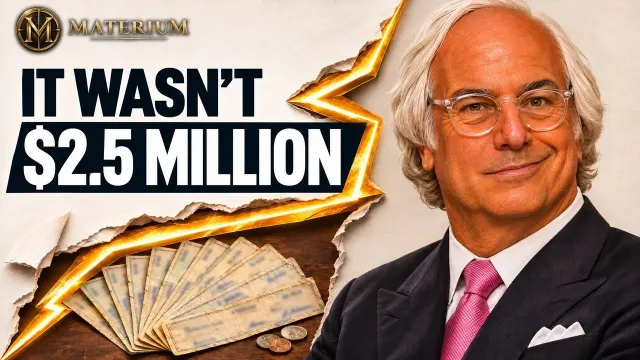
Sergei Mavrodi and MMM, Russia's biggest pyramid scheme scam (Moscow, 1994) Moscow, 1994: millions of people buy MMM shares whose price isn't set by the market but by its founder, twice a week. And it only goes up. When the state steps in, many shareholders don't turn against him. How do you earn that kind of loyalty? Told with the press of the time, Mavrodi's own interviews and regulators' warnings.
The case file
Who is who, where each person stands legally and where every figure comes from. Primary sources come first: court rulings, regulators and filings.
Key people
- Serguéi MavrodiFounder of MMM and its successors, MMM-2011 and MMM GlobalSentenced to 4 years and 6 months for fraud in April 2007; died of a heart attack in Moscow on March 26, 2018
- Viacheslav MavrodiYounger brother and co-founder of the MMM cooperative in the late 1980sIn March 2018 he refused to let his brother be buried in the family plot, according to Russian press reports
- Vladímir PermiakovActor who played Lyonya Golubkov, the everyman of MMM's 1994 TV adsIn September 2011 he fronted ads for MMM-2011 in Ukraine, according to the Ukrainian outlet Dengi.ua
- Nadezhda MárkinaJudge at Moscow's Chertanovsky court who tried MavrodiIn April 2007 she read an 820-page verdict: fraud against 10,000 investors totaling 110 million rubles
- Alberto DiamondPanama's Superintendent of Banks, who signed the warning against MMMOn July 12, 2012, he signed Public Notice 16-2012 against Mavrodi's “pyramid financial scheme”
The numbers and their source
| Item | Figure | Source |
|---|---|---|
| MMM share price before and after July 29, 1994 | From about 115,000 rubles to 1,000 in one day | Kommersant, “Падение курса акций АО МММ” (July 30, 1994) |
| Losses and victims recognized in the 2007 verdict | 110 million rubles ($4.3 million) and 10,000 investors | The Moscow Times, “Mavrodi Convicted of Fraud in MMM Trial” (2007) |
| Russians who lost their savings in 1994, and investigators' estimate of the take | 2 to 10 million people; up to $100 million (other estimates go as high as 15 million people) | The Moscow Times, “Mavrodi Convicted of Fraud in MMM Trial” (2007) |
| Return MMM promised in Nigeria (2016) | 30% a month | CNN, “‘MMM’ Ponzi scheme remains popular in Nigeria” (December 14, 2016) |
| People affected and losses in Nigeria per the NDIC, citing social media (2017) | ≈ 3 million people and ₦18 billion | Daily Trust, NDIC estimate of MMM losses in Nigeria (2017) |
| Court-ordered debts to former investors he left when he died in 2018 | More than 1.6 billion rubles across 200+ enforcement orders | Snob, “Mavrodi left more than 1.6 billion rubles in debts” (bailiffs' data, 2018) |
Primary documents
- SEC Nigeria, public notice on MMM Federal Republic of Nigeria (August 30, 2016, archived copy) web.archive.org
- Superintendency of Banks of Panama, Public Notice 16-2012 superbancos.gob.pa
- Bank of Russia, warning list: “MMM Reborn” cbr.ru
- Superintendency of Banks of Panama, Circular SBP-DJ-0063-2012 to banks on MMM (July 12, 2012) superbancos.gob.pa
- Russian Federal Financial Markets Service (Bank of Russia archive): antitrust panel finds signs of a pyramid in MMM-2011 (January 21, 2011) cbr.ru
- Sergei Mavrodi's MMM-2011 website (archived copy, 2011) web.archive.org
- Before you join a “mutual aid” group, ask where the payouts come from. If the answer is “new members,” walk away.
- Search the name on your regulator's warning list and on foreign ones too: Panama and Nigeria both flagged MMM.
- If payouts freeze “for maintenance” or “until after the holidays,” don't add a single dollar to unlock what you already put in.
Episode transcript
The full narration, split by the video chapters.
0:00 Thirteen shareholders stopped eating
This man built the biggest pyramid scheme in Russian history. When the police arrested him, thirteen of his shareholders stopped eating. To get him released. Months later, they voted him into parliament.
I never hid why I was going to the Duma. He died alone, owing his victims more than one point six billion rubles. And someone paid for his funeral. The MATERIUM team investigated this case through real documents: regulators’ warnings, the scheme’s own websites, and the press of the time.
0:36 Two to fifteen million people
His name was Sergei Mavrodi. No one knows how many people gave him their money: between two and fifteen million, depending on the estimate. McFarland was booed when he fell. Mavrodi's victims defended him.
You'd think a pyramid scheme would hide. This one posted it on the door. And millions still walked in. In Russia.
In Nigeria. Even in Peru. And it all starts in the Moscow metro.
1:09 The mathematician and the share that only goes up
Sergei Mavrodi is a mathematician. A programmer. At twenty-six, he drops everything and becomes a night watchman in the metro. He copies and sells bootleg tapes of Western music and movies.
Black market. In the late eighties, he founds a cooperative with his brother and sister-in-law. Three partners. Three initials.
MMM. In February nineteen ninety-four, MMM sells shares to the public. With a rule nobody else has: the market doesn't set the price. He does.
Twice a week. And it only goes up. In six months, a share goes from sixteen hundred rubles to over a hundred thousand.
1:58 Lionia Golubkov, the master key
But a rising price isn't enough. People have to believe it. And Mavrodi doesn't put a celebrity on TV. He casts a neighbor.
Lionia Golubkov, an excavator operator, collects his dividends and buys his wife a pair of boots. In another ad, his older brother chews him out: You're a freeloader, Lionia! We were raised to earn an honest living! I earn it with my excavator and I invest it.
I'm not a freeloader! I'm a partner! Years later, Mavrodi put it bluntly: Lionia Golubkov was a master key to every soul. And the director of the ads recalled his motto: People who think they're smart don't interest us.
We're interested in everyone else. Seventeen years later, he'd go after the smart ones. By telling them the truth.
3:02 The lines on Varshavskoye Highway
Then come the lines. Varshavskoye Highway, number twenty-six. MMM's headquarters. Some people mortgaged their apartments or their garages.
This is Russia in nineteen ninety-four. Prices soaring. Wages that go unpaid for months. A pensioner with two hundred shares sums it up: We don't believe in the government.
We believe in MMM. In April, she bought shares at one dollar each. In July they were selling for fifty. Look at those lines.
They're the first clue to who paid for his funeral. But in July, the state steps in. The tax police demand more than twenty-four million dollars in taxes and fines. Thousands of investors surround the headquarters.
Riot police arrive. Mavrodi answers with a full-page open letter. He blames the government: What form will the fury of the robbed take? Revolution?
Civil war? I don't know.
4:16 "What president? Mavrodi."
In those days, something strange happens in the line. I sold my gold ring for my son's education. Why did the government allow this? Every game is a risk.
And it's not the president's fault. He's an honest, noble man. What president? Yeltsin?
Mavrodi. July twenty-ninth. Mavrodi cuts the price himself. Days earlier, a hundred and fifteen thousand rubles a share.
Now, one thousand. And he announces it without batting an eye: They stopped us on the eve of a great leap. But the state isn't done. Six days later, Interior Ministry troops storm his apartment.
They arrest him. But not for the pyramid. For taxes. Running a pyramid scheme wasn't a crime in Russia.
It wouldn't be until twenty sixteen. But his victims don't turn on him. They turn on the state. Sit-ins in Red Square.
Thirteen shareholders on hunger strike. A banner: “Hands off Mavrodi.” Two weeks later, MMM reopens. More than two thousand people line up in the rain. Not to sell.
To buy again. A pensioner who'd put in a hundred and twenty thousand rubles explains: He's a good man. He didn't deceive us. The government deceived us.
Maybe this sounds familiar. If you or a family member was offered an investment that “only goes up,” tell us in the comments. Your story could be the warning another family needs. Mavrodi is still behind bars.
But outside, there's an empty seat. In Mytishchi, north of Moscow, the local deputy has been murdered. There's an election for his seat. From his cell, Mavrodi files to run, and the law forces his release.
His promise: if he wins, MMM will buy back every share. On October thirtieth, he wins. About twenty-eight thousand votes: observers credited them to MMM's twenty-eight thousand shareholders in the district. The next day, he suspends trading in the shares.
And when he picks up his credentials: My promises were not empty words. Sixteen years later, an interviewer asked him point-blank. Confess. Did you buy the seat?
I didn't need to. I won easily. But if I could have, I'd have gladly bought it. I never hid why I was going to the Duma.
For the immunity. Yes. I couldn't care less about making laws. And did you go to the sessions?
Not a single one. Just the first day. When I arrived, almost every deputy came running to cash in their tickets. They were playing too.
The immunity would last him less than a year. His victims' loyalty would outlast his life. But the Duma has had enough. In October nineteen ninety-five, it strips him of his seat.
He kept doing business. In nineteen ninety-seven, MMM goes bust. And Mavrodi vanishes. He never accepted that his pyramid had collapsed: The pyramid collapsed?
Nonsense. It worked perfectly. The state stepped in and caused the panic. A year later, it's the state itself that goes bust: it paid its bonds by issuing more bonds.
In August nineteen ninety-eight, Russia defaults. Mavrodi wasn't the only one playing. Who was more to blame: the man who built the pyramid, or the state that took twenty-two years to ban them? Let me know in the comments.
Meanwhile, police are hunting for him halfway around the world. And he's just around the corner. In two thousand three, they find him renting in his own neighborhood, with a fake passport. He'd tell it like this: I was hiding in the building next door.
Nobody looks right next door. Two thousand seven. Out of millions of victims, the case covers ten thousand three hundred sixty-six: only the ones who filed claims. Damages at trial: about four million dollars.
In the courtroom, many elderly women. Many of them, victims. And they defend him. Let him go.
He hasn't killed anyone. By his own account, he told a pensioner who was crying: I feel for you. But you could sell anytime. You could have made a hundred times more.
Wasn't that enough? The verdict sums it up: Through deception, betrayal and abuse of trust. Four and a half years. He had already served almost all of it in pretrial detention.
Twenty-five days later, he walked free. His last bill, the funeral, wouldn't be paid by his family. But first, he'd be back. This time, he'd post it on the door.
10:04 MMM-2011: "This is a financial pyramid"
January twenty eleven. On his blog, Mavrodi announces MMM twenty eleven. Twenty percent a month. Thirty for retirees.
His website pitches it like this: Buy MAVRO, lie back on the couch and watch the price go up. And on the door, in red on yellow, he warns: Warning. This is a financial pyramid. You can lose all your money at any moment.
When the regulator looks into whether it's a pyramid, he answers on the radio: It says so on my blog in red letters! It's a pyramid. But pyramids aren't against the law. The confession doesn't scare people off.
It draws them in. A fund manager had already seen it in nineteen ninety-four: People knew MMM wasn't honest. They thought they'd get their money out before the end. And Mavrodi knows how it spreads: Why don't you join?
Because you have doubts. But if tomorrow a relative of yours really gets paid, you'll join. That network spawns a group with its own name: the MMM twenty eleven Guard. In Ukraine, Lionia Golubkov returns.
With a new script: I had to sell the excavator. And we never built the factory. In May twenty twelve, MMM twenty eleven freezes payments. In June, Mavrodi explains it on video: Of course there won't be money for everyone.
It's a pyramid! Whatever's missing, we'll take from MMM twenty twelve. A pyramid that pays its debts with the next pyramid. But Russia is too small for him.
India, Indonesia, China, South Africa: the same warning, in every language. In April twenty sixteen, MMM Global admits its “Bitcoin Republic” can't pay. Two weeks later, on Freedom Day, a march of “Mavrodians” blocks a street in Soweto for two hours. One participant shows off her new Range Rover, paid for in cash: It was the perfect birthday present from the Mavrodians.
By the way: if you know a con artist whose story deserves a chapter, drop it in the comments. We investigate the most requested ones. But his biggest score would come in Nigeria. With a message that began: “Everything is fine.” Nigeria, late twenty fifteen.
Thirty percent a month. From bank account to bank account: one “provides help,” another “gets help.” To join, you have to check a box: “I've read the WARNING. Now I am fully aware of the risks.” Remember that box. It'll be back the day he's gone.
In August twenty sixteen, Nigeria's Securities and Exchange Commission puts it in writing: it's a Ponzi scheme. A letter arrives, signed by Mavrodi: What will they tell a mother who can't feed her child? December thirteenth, twenty sixteen. Twelve days before Christmas, MMM Nigeria posts a notice: “Everything is fine.
Everyone is getting paid. But just to be safe: everything is frozen for a month.” I was due to be paid two days before the freeze. The person I was matched with never paid. It's temporary.
Saving the system is saving our money. In January it will be back, and stronger. They say to wait until someone new joins. I have no choice but to stay optimistic.
In February, another letter signed by Mavrodi changes the rules: Under this rule, you can't get paid without paying in again. Nigeria's deposit insurance agency estimated some three million people were affected. Eighteen billion naira. In Russia and in Nigeria, there were people who, after losing everything, took their own lives.
No one knows how many. But the warning was also written in Spanish. Panama, July twenty twelve. The Superintendency of Banks warns: Spanish-language emails are circulating that promote Mr.
Mavrodi's pyramid. His Spanish-language site gave a one-line warning: “Don't be greedy.” Huancayo, Peru, November twenty seventeen. MMM presents itself as a “mutual aid financial social network.” Thirty percent a month. A participant celebrates in front of the cameras: I put in five thousand soles and got back eight thousand five hundred eighty-nine.
At their meetings, Sergei Mavrodi's photo is displayed with reverence. They march with it. And they nearly attack the reporter who warns them. Today, the same scheme goes by other names: the loom, the flower, the mandala of abundance. “Mutual aid.” And thirty years later, Lionia fell for it too.
In twenty twenty-five, the actor who played him said fake lawyers had taken a hundred and eighty-three thousand rubles from him. They promised to raise his pension. If getting paid depends on someone new joining, it's not mutual aid. It's a pyramid.
Do your parents, grandparents or friends get WhatsApp invitations to a “loom” or to “mutual aid”? Send them this video. Maybe they don't need it today. Hopefully they never will.
And if you think it could help someone, hit like: that way it reaches more people. But while his photo was being paraded in Peru, Mavrodi had four months left to live. Moscow, March twenty eighteen. One in the morning.
A sixty-two-year-old man falls ill at a bus stop on Polikarpova Street. He dies in the hospital at six forty. Heart attack. His body spends four days in the morgue.
No one claims it. If no one comes forward, the state will bury him. His brother won't let him lie beside their parents. He leaves more than two hundred claims from former investors: one billion six hundred and seven million rubles.
Then someone shows up. March thirty-first. Troyekurovskoye Cemetery. Closed casket.
Secret ceremony. According to a lawyer, the money came from members of the MMM twenty eleven Guard. His second pyramid. The one that had warned them: you can lose everything.
The Guard's spokeswoman: It was paid for by private individuals who consider the deceased an exceptional personality. Weeks later, MMM announces it's closing for good. Not a word about returning the money. Just a reminder: everyone had read the warning.
And they had confirmed it by checking the box. Today, on the Bank of Russia's warning list, there's a network that bears his name: “MMM Reborn. Sergei Mavrodi Financial Network.” In twenty fourteen, wanted by the police, he said it with a smirk: Banks are ordinary swindlers. That's my opinion.
Wrong, of course. I'm a swindler myself. He hid from the police, yes. From his victims, never.
He didn't need to. Because when the victims defend the con man, he no longer needs to hide.
18:50 Law No. 11 and what comes next
Law number eleven: when the victims defend the con man, he no longer needs to hide. Five left. In the next chapter: millions believed Mavrodi's legend. The next one, the whole world believed: Hollywood told it… and almost none of it was true.
See that code in the corner? If I were you, I wouldn't scan it. Of course, that's exactly what a con man would tell you. Link in the description and in the pinned comment.
Subscribe. Because the next victim could be you.
Test your instincts
Would you fall for this scam?
Question 1 of 2