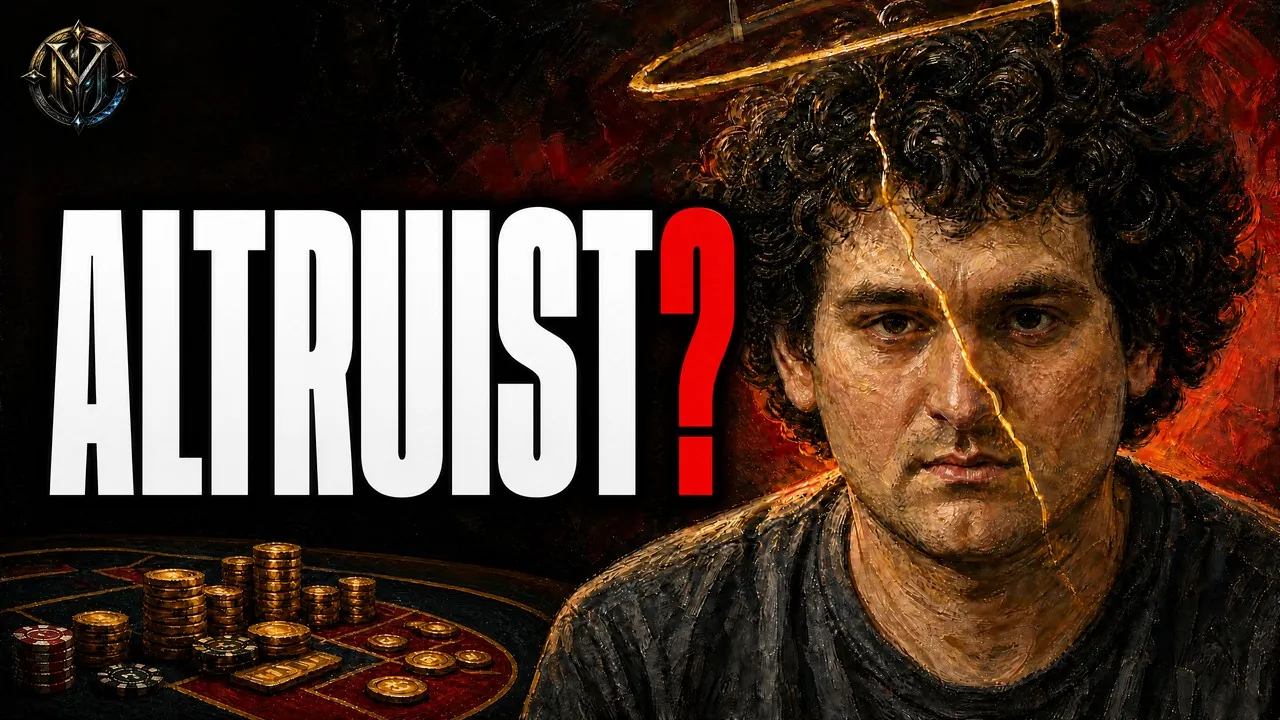
Sam Bankman-Fried, founder of the crypto exchange FTX, secretly used his customers' money through his trading firm, Alameda Research. According to prosecutors, about $8 billion of customer deposits ended up at Alameda, which invested it, lent it out and spent it on real estate, donations and sponsorships. When customers tried to withdraw their money in November 2022, it wasn't there: FTX collapsed into bankruptcy on November 11. Bankman-Fried was found guilty on seven counts in November 2023 and sentenced to 25 years in March 2024. As of October 2026 he is serving his sentence in a federal prison in California, his pardon petition is still pending and he has taken his case to the Supreme Court.
In 30 seconds
- FTX's terms of service told customers that their assets belonged to them at all times.
- From July 31, 2019, a setting in the code allowed Alameda, and only Alameda, to trade with a negative balance.
- When FTX went bankrupt it held 105 bitcoins against nearly 100,000 that customers were owed, according to prosecutors.
- By 2026 customers had received 105% of their claims, but at November 2022 prices.
Timeline
Sam Bankman-Fried founds the crypto trading firm Alameda Research.
He launches FTX; on July 31, the code setting that lets Alameda trade into the negative is switched on.
CoinDesk publishes Alameda's balance sheet, full of FTT, the token created by FTX.
FTX files for bankruptcy; John J. Ray III takes charge.
Bankman-Fried is arrested in the Bahamas and extradited to the United States.
A New York jury finds him guilty on all seven counts.
Judge Lewis Kaplan sentences him to 25 years in prison.
His pardon petition is listed and the Second Circuit upholds the conviction.
The Senate passes a non-binding resolution against a pardon; customers have received 105%.
He asks the Supreme Court to review his conviction and the $11 billion forfeiture.
Who is Sam Bankman-Fried?
Bankman-Fried was born in 1992 and grew up around Stanford University, the son of two law professors, and studied physics at MIT. He worked at a Wall Street firm specializing in quantitative trading and made his name championing effective altruism: earning a lot of money in order to give it away. In 2017 he founded Alameda Research, a crypto trading firm that took off by exploiting the fact that bitcoin traded at a higher price in Japan than in the United States. In 2019 he opened, alongside it, a platform for buying and selling cryptocurrencies: FTX.
The shop window was enormous. The leadership set up in a penthouse in the Bahamas, FTX paid $135 million to put its name on the Miami Heat's arena, signed Tom Brady as an ambassador and ran a Super Bowl ad. In December 2021 Bankman-Fried told Congress that FTX's systems ensured no customer account could go negative.
What did SBF do? How the FTX fraud worked
On an exchange there is one basic rule: you can't take out more than you have. FTX co-founder Gary Wang explained at trial that the code had a setting, “allow negative,” that let an account get around that rule. It was switched on on July 31, 2019, for a single account: Alameda's. That same day Bankman-Fried wrote on Twitter that Alameda's account was just like any other customer's. When the prosecutor asked Wang whether that was true, he answered: “No.” According to his testimony, Alameda came to have a $65 billion line of credit inside FTX.
There was a second route. To deposit dollars, many customers wired money to a company called North Dimension, which was not FTX but an Alameda subsidiary. That money stayed at the fund. With it, according to the indictment and the trial evidence, Alameda bought more than $100 million in real estate in the Bahamas, lent more than $1 billion to Bankman-Fried himself, made political donations and invested $500 million in a small artificial intelligence company, Anthropic.
In June 2022, with the crypto market falling, Alameda's lenders asked for their money back. Caroline Ellison, who ran the fund, testified that Bankman-Fried asked her to prepare alternative ways of presenting the balance sheet, and that she prepared seven versions. To repay the loans, Alameda took more customer money. It is the mechanism we explain in crypto scams: the risk is not only in the coin, but in who holds it.
The FTX collapse: nine days in November 2022
On November 2, 2022, CoinDesk published Alameda's balance sheet: a large part of its assets was FTT, the token FTX itself had created. The founder of Binance, its big rival, announced he was selling all his FTT, and a stampede of withdrawals began. On November 7 Bankman-Fried tweeted that FTX was fine and that assets were fine. At trial, Wang testified: “FTX was not fine, and assets were not fine.” The next day FTX halted withdrawals. On November 11 it filed for bankruptcy.
FTX's new chief was John J. Ray III, a specialist in winding down failed companies who, between 2004 and 2009, had chaired the entity that recovered money for Enron's creditors. In his first declaration to the court he wrote that never in his career had he seen such a complete failure of corporate controls. Before Congress he said there was nothing sophisticated about it: it was old-fashioned embezzlement.
The trial and Sam Bankman-Fried's sentence
In December 2022 Bankman-Fried was arrested in the Bahamas and extradited. He was released on a $250 million bond to his parents' home, until the judge revoked his bail after finding he had tried to pressure a witness. In October 2023, in Manhattan, his closest associates, who had already pleaded guilty, testified against him. Ellison said he had directed her to commit the crimes. On November 2, 2023, the jury found him guilty on all seven counts.
On March 28, 2024, Judge Lewis Kaplan sentenced him to 25 years and an $11 billion forfeiture. He told him that he knew what he was doing was wrong and that it was criminal. In June 2026 the Second Circuit Court of Appeals upheld the conviction. On September 10, 2026, he asked the Supreme Court to review it; the government has until November 16 to respond.
What did FTX customers get back?
This is the twist that gives this case its law. Ray's team recovered assets: it sold the Robinhood shares, clawed back donations and sold the stake in Anthropic, which had soared in value with the artificial intelligence boom. Crypto prices rose too. According to the FTX Recovery Trust, after the fifth distribution, in July 2026, customers had received a cumulative 105% of their claims, and those with small accounts around 120%.
But those claims were valued at the price on the day of the bankruptcy. In the bankruptcy, one bitcoin was valued at about $16,871; today it is worth several times more. Someone who held one bitcoin on FTX and received 120% got about $20,000 for something now worth much more. At the sentencing hearing, customer Sunil Kavuri compared it to having your house stolen, sold for more, and being handed back its price on the day of the theft. Judge Kaplan agreed: the claim that customers would be made whole was misleading. On top of that, much of what was returned came from bets made with customers' own money that happened to pay off. Bankman-Fried maintains from prison that FTX was solvent; the appeals court concluded that customers were defrauded as soon as their money went to Alameda.
The Sam Bankman-Fried pardon: status as of October 2026
According to CNBC's June 2026 reporting, based on the website of the Justice Department's Office of the Pardon Attorney, a pardon petition in his name is on file; according to CNN, it asks for a pardon after completion of his sentence. As of October 21, 2026, no decision has been announced. In January 2026 Donald Trump said in an interview with The New York Times that he had no plans to pardon him. On July 15, 2026, the Senate unanimously passed a non-binding resolution saying he should receive neither a pardon nor a commutation. Trump did pardon Binance founder Changpeng Zhao in 2025, who had been convicted of a different crime. According to the Federal Bureau of Prisons, Bankman-Fried's projected release is in December 2043.
Law of Deception No. 16: how to spot the same trap today
The law that closes the season in the Laws of Deception is this: getting your money back doesn't mean it wasn't stolen. The theft doesn't begin when the money goes missing, but when it leaves your account without your permission. The lever was trust: a founder presented as a philanthropist genius, arenas, celebrities and testimony before Congress. It is the same trap as the fifteen cases before it in a different disguise, as our list of the biggest scams in history shows.
Signs worth watching for today:
- Who holds your assets? On a platform, your crypto depends on the platform. If it goes bankrupt, you may end up being paid its value on the day of the bankruptcy.
- Related companies. If the platform and an investment fund have the same owner, ask what keeps customer money separate from the fund's.
- Deposits in another company's name. If you have to wire money to a company with a different name to deposit, find out why.
- Its own token as a cushion. A balance sheet full of tokens created by the company itself is not a safety net.
- Celebrity marketing and sponsorships. No arena guarantees your deposits.
In the United States there is no single federal license for crypto exchanges: check that the platform is registered with FinCEN as a money services business and licensed in your state (in New York, by the Department of Financial Services), and remember that crypto held on an exchange is not covered by FDIC insurance or by SIPC. In the United Kingdom, cryptoasset firms must be registered with the FCA: check the FCA Register and its warning list, and bear in mind that crypto is not protected by the FSCS. Report fraud to the FTC at ReportFraud.ftc.gov or to the SEC in the US, or to Report Fraud (formerly Action Fraud) in the UK. If you've already been scammed, beware of anyone who promises to recover your money for a fee: that is the recovery scam. Our guide on how to spot a scam brings together the basic checks.
Watch the full episode
Episode 16, the finale of MATERIUM's first season, reconstructs the case with the trial transcripts, John J. Ray III's declaration and the 2026 bankruptcy distributions. It is in the episode on Sam Bankman-Fried and FTX.
 The full episodeFTX: They Got 105% Back… and Were Still Robbed
Subscribe for the premiere
Frequently asked questions
What did Sam Bankman-Fried do?
He founded the crypto exchange FTX in 2019 and, according to the court's findings, let his trading firm Alameda Research secretly use billions of dollars deposited by FTX customers to invest, lend, buy real estate and make donations. In November 2022 FTX could not return the deposits and went bankrupt.
How long is Sam Bankman-Fried's sentence?
He was found guilty on seven counts of fraud and conspiracy on November 2, 2023, and sentenced to 25 years in prison on March 28, 2024, with an $11 billion forfeiture. The Second Circuit Court of Appeals upheld the conviction in June 2026.
Did FTX customers get their money back?
According to the FTX Recovery Trust, by July 2026 customers had received a cumulative 105% of their claims, and those with small accounts around 120%. But the claims were valued at November 2022 prices, when one bitcoin was worth about $16,871.
Has Sam Bankman-Fried been pardoned?
No. As of October 21, 2026, his pardon petition, listed since June 2026 with the Justice Department's Office of the Pardon Attorney, is still pending. The Senate passed a non-binding resolution against it in July, and in January Trump told The New York Times he had no plans to pardon him.
Sources
- US Department of Justice, Samuel Bankman-Fried sentenced to 25 years (2024)
- U.S. Attorney's Office, Southern District of New York, statement after the verdict (2023)
- SEC, complaint against Samuel Bankman-Fried (December 2022)
- John J. Ray III, first-day declaration in the FTX bankruptcy (November 17, 2022)
- FTX, announcement of the fifth distribution to creditors (July 2026)
- CNBC, Bankman-Fried files a formal request for a presidential pardon (June 8, 2026)
- CNN, Sam Bankman-Fried asks Trump for a pardon (June 8, 2026)
- Decrypt, the Senate unanimously opposes a pardon (July 2026)
- US Supreme Court, Bankman-Fried's petition for a writ of certiorari, No. 26-349 (2026)